
Regarding India's first solar observatory, the year 2026 is expected to be like no other.
This marks the initial occasion the spacecraft – that entered in orbit last year – can observe the Sun during its maximum activity cycle.
As per research, this occurs roughly every 11 years when the Sun's magnetic poles flip – the Earth equivalent would be the North and South poles swapping positions.
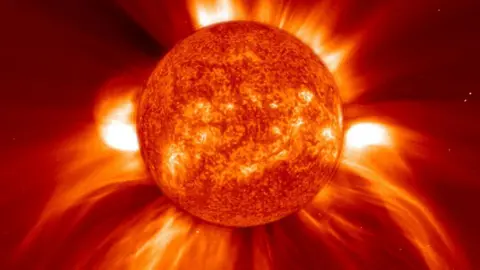
It's a time of great turbulence. It sees the Sun changing from peaceful to violent and features a significant rise in the frequency of solar storms and massive solar flares – massive bubbles of plasma that blow out of the Sun's outermost layer.
Made up of ionized particles, a CME may have a mass up to a trillion kilograms and can attain velocities of up to 3,000km each second. It can travel toward various directions, including towards our planet. At top speed, the journey takes a CME 15 hours to cover the vast distance Earth-Sun distance.
"In the normal or low-activity times, the Sun emits a few solar eruptions daily," says a leading scientist. "In 2026, we expect there will be 10 or more each day."
Researching CMEs is one of the key research goals for the Indian maiden solar mission. One, because the ejections offer a chance to study the star at the centre of our planetary system, and secondly, since events that take place on the solar surface endanger systems on Earth and in space.

Effects on Earth and Space Infrastructure
Coronal mass ejections rarely pose a direct threat to human life, yet they impact our planet by causing geomagnetic storms affecting conditions in near space, where about thousands of spacecraft, comprising many from India, orbit.
"The most spectacular manifestations of a CME include northern lights, being a clear example that charged particles from Sun journey to Earth," the scientist explains.
"However, they may make all the electronics aboard spacecraft fail, knock down power grids and affect weather and communication satellites."
Historical Solar Events
- The most powerful solar storm ever recorded occurred during the 1859 solar superstorm that disabled telegraph lines worldwide
- During 1989, sections of Canadian electrical network failed, leaving six million people without power for hours
- During late 2015, solar activity disrupted air traffic control, leading to chaos across Scandinavia and various European airports
- Recently in 2022, a CME had led to dozens of spacecraft being lost
With capability to observe events in the solar atmosphere and spot a solar storm or solar eruption in real time, measure its heat at origin and watch its trajectory, it can work as a forewarning to switch off electrical systems and spacecraft and move them to safety.
Aditya-L1's Unique Advantage
While other space observatories observing our star, India's spacecraft has an advantage over others when it comes to watching the corona.
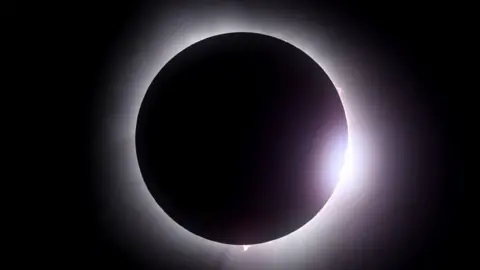
"Aditya-L1's coronagraph has perfect dimensions enabling it to nearly mimic the Moon, completely blocking the solar disk permitting an uninterrupted view of almost all solar atmosphere 24 hours a day, throughout the year, even during eclipses and occultations," says the researcher.
Essentially, this instrument acts like an artificial Moon, blocking the Sun's bright surface to let researchers constantly study its faint outer corona – something the real Moon does only during specific moments.
Additionally, this is the only mission capable of examining solar events using optical wavelengths, enabling it to measure eruption heat and heat energy – crucial data indicating how strong of an eruption if it headed toward Earth.
Preparation for Peak Period
In preparation for the upcoming solar maximum, scientists collaborated to study information gathered from a major CMEs that Aditya-L1 has recorded until now.
This event began in September 2024 during early hours. The eruption's weight totaled billions of tons – the iceberg that sank Titanic was 1.5 million tonnes.
At origin, its temperature reached extreme levels and the energy content comparable to millions of tons of explosives – relative to nuclear weapons on Hiroshima and Nagasaki were much smaller and 21 kilotons respectively.
Although the numbers make it sound incredibly large, the scientist classifies it as a "medium-sized" one.
The asteroid that eliminated the dinosaurs on our planet was 100 million megatons and when the Sun's maximum activity cycle, we could see CMEs carrying power equal to greater levels.
"I consider the CME we analyzed to have occurred during periods was in the normal activity phase. Now this sets the benchmark that we'll be using to evaluate what is in store during solar maximum occurs," he states.
"The learnings gained will assist in developing the countermeasures to implement to protect spacecraft in near space. Additionally, they'll aid us gain deeper knowledge of our space environment," he concludes.


